How AI Automation Is Transforming Modern Businesses in 2026
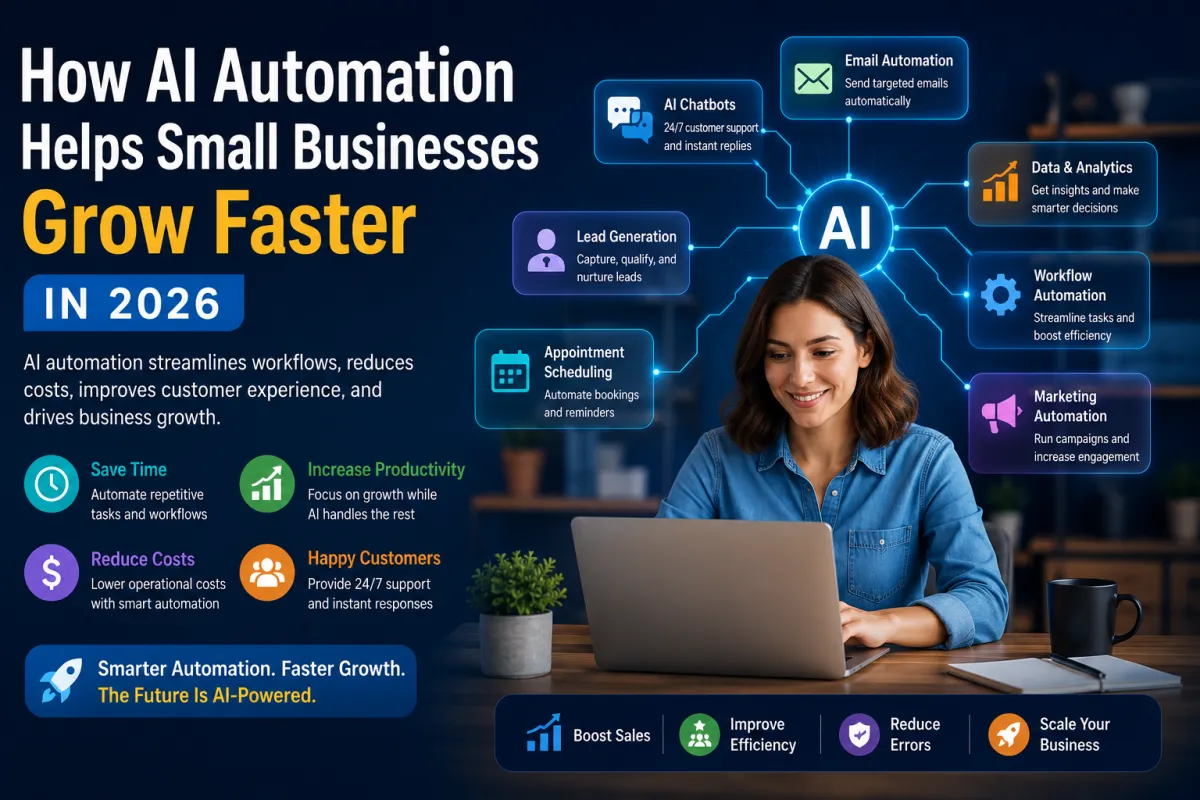
In 2026, businesses are evolving faster than ever before. Companies across every industry are under pressure to improve efficiency, reduce operational costs, deliver better customer experiences, and scale rapidly in an increasingly digital world. To stay competitive, businesses are turning to one powerful solution: AI automation.
Artificial intelligence (AI) automation is no longer limited to large corporations with massive budgets. Today, startups, agencies, eCommerce brands, SaaS companies, healthcare providers, and local businesses are all using AI-powered systems to streamline operations and accelerate growth.
From automated customer support and marketing campaigns to intelligent CRM systems and predictive analytics, AI automation is transforming how businesses operate in 2026.
In this comprehensive guide, we will explore how AI automation is reshaping modern businesses, its biggest benefits, real-world applications, and why companies that adopt AI early are gaining a major competitive advantage.
What Is AI Automation?
AI automation refers to the use of artificial intelligence technologies to perform tasks automatically with minimal human intervention.
Unlike traditional automation systems that follow fixed rules, AI-powered automation can:
-
Learn from data
-
Adapt to changing situations
-
Make predictions
-
Analyze customer behavior
-
Improve workflows over time
AI automation combines machine learning, natural language processing, predictive analytics, and workflow automation to help businesses work smarter and faster.
Why AI Automation Matters in 2026
Businesses today face multiple challenges, including:
-
Rising operational costs
-
Increased customer expectations
-
Competitive digital markets
-
Limited workforce productivity
-
Large amounts of customer data
-
Demand for 24/7 customer support
AI automation helps solve these challenges by reducing manual work, improving efficiency, and allowing businesses to scale without dramatically increasing costs.
Companies that fail to adopt AI automation risk falling behind competitors that operate faster and more efficiently.
1. AI Automation Improves Business Efficiency
One of the biggest advantages of AI automation is operational efficiency.
Businesses waste countless hours on repetitive tasks such as:
-
Data entry
-
Email responses
-
Appointment scheduling
-
CRM updates
-
Invoice generation
-
Lead follow-ups
AI-powered systems can automate these tasks instantly and accurately. This allows employees to focus on higher-value activities such as strategy, innovation, and customer relationships.
As a result, businesses become more productive while reducing operational bottlenecks.
2. AI Automation Enhances Customer Support
Customer expectations have changed significantly.
Modern customers expect:
-
Instant responses
-
24/7 availability
-
Personalized interactions
-
Faster problem resolution
AI automation helps businesses meet these expectations through:
-
AI chatbots
-
Automated ticketing systems
-
Smart email responses
-
Conversational AI assistants
These systems can answer common questions, resolve simple issues, and direct complex cases to human support agents.
This improves customer satisfaction while reducing support costs.
3. AI Automation Improves Lead Generation
Lead generation is essential for business growth, but managing leads manually is time-consuming.
AI automation helps businesses:
-
Capture leads automatically
-
Qualify prospects
-
Analyze customer intent
-
Score leads based on behavior
-
Send personalized follow-ups
For example, when a visitor interacts with a website, AI systems can track their activity and identify whether they are likely to convert.
Businesses can then prioritize high-quality leads and improve sales performance.
4. AI Automation Personalizes Marketing Campaigns
Generic marketing is becoming less effective. Customers now expect personalized experiences tailored to their interests and behaviors.
AI-powered marketing automation tools can:
-
Segment audiences automatically
-
Analyze customer behavior
-
Send personalized emails
-
Recommend products
-
Optimize ad campaigns
For example, eCommerce businesses use AI to recommend products based on browsing history and previous purchases.
This increases engagement, conversions, and customer loyalty.
5. AI Automation Strengthens CRM Systems
Customer Relationship Management (CRM) systems are becoming increasingly intelligent with AI integration.
Modern AI-powered CRMs can:
-
Track customer interactions
-
Predict buying behavior
-
Automate follow-ups
-
Identify upsell opportunities
-
Generate sales insights
This helps businesses build stronger customer relationships while improving sales efficiency.
Platforms like GoHighLevel, HubSpot, and Salesforce are leading this transformation with advanced AI features.
6. AI Automation Reduces Operational Costs
Reducing costs while maintaining quality is a major priority for businesses.
AI automation helps reduce expenses by:
-
Automating repetitive tasks
-
Minimizing manual labor
-
Reducing human errors
-
Improving workflow efficiency
-
Optimizing resource allocation
Instead of hiring large teams for administrative tasks, businesses can use AI systems to manage operations more efficiently.
This is especially valuable for startups and small businesses with limited budgets.
7. AI Automation Supports Better Decision-Making
Modern businesses generate massive amounts of data every day.
AI automation systems can analyze this data and provide actionable insights such as:
-
Best-performing marketing campaigns
-
Customer purchasing patterns
-
Revenue forecasts
-
Sales trends
-
Customer churn risks
This allows business owners to make smarter, data-driven decisions rather than relying on guesswork.
AI-powered analytics improve planning, forecasting, and business strategy.
8. AI Automation Enables 24/7 Business Operations
Traditional businesses often rely on working hours and staff availability.
AI automation allows businesses to operate continuously by:
-
Responding to inquiries instantly
-
Scheduling appointments automatically
-
Sending notifications
-
Processing orders
-
Managing workflows
This ensures businesses remain responsive even outside normal business hours.
As a result, businesses can serve customers globally and improve overall customer experience.
9. AI Automation Improves Employee Productivity
Employees often spend too much time on repetitive tasks.
AI automation reduces workload by handling routine processes automatically.
This helps employees:
-
Focus on creative work
-
Improve productivity
-
Reduce burnout
-
Increase efficiency
-
Spend more time on customer relationships
Businesses that empower teams with AI tools often achieve faster growth and better performance.
10. AI Automation Helps Businesses Scale Faster
Scaling a business requires efficient systems.
Without automation, growth often creates operational chaos.
AI automation helps businesses scale by:
-
Streamlining workflows
-
Managing larger customer volumes
-
Automating communication
-
Organizing data efficiently
-
Supporting remote teams
This allows businesses to grow without proportionally increasing operational costs.
Industries Benefiting from AI Automation
1. Marketing Agencies
-
Automated campaigns
-
Lead nurturing
-
CRM management
2. eCommerce Businesses
-
Product recommendations
-
Customer support
-
Inventory forecasting
3. Healthcare Providers
-
Appointment scheduling
-
Patient communication
-
Workflow management
4. SaaS Companies
-
Customer onboarding
-
Subscription management
-
AI support systems
5. Real Estate Businesses
-
Lead management
-
Automated follow-ups
-
Client communication
Challenges of AI Automation
Although AI automation offers major benefits, businesses may face challenges such as:
-
Initial implementation costs
-
Learning curves
-
Data privacy concerns
-
Integration complexity
-
Over-reliance on automation
However, proper planning and human oversight can minimize these risks.
Best Practices for Implementing AI Automation
Businesses can maximize success by following these strategies:
Start Small
Begin with simple workflows before expanding automation across departments.
Focus on High-Impact Areas
Automate repetitive tasks that consume the most time.
Train Employees
Ensure teams understand how to use AI systems effectively.
Monitor Performance
Track results and optimize workflows regularly.
Combine AI with Human Oversight
Use AI to support employees rather than replace all human involvement.
The Future of AI Automation
The future of AI automation is rapidly evolving.
Upcoming trends include:
-
Fully autonomous business systems
-
AI-powered virtual assistants
-
Predictive customer journey automation
-
Voice-controlled business operations
-
Real-time AI personalization
-
Advanced AI analytics
Businesses that embrace these technologies early will gain significant advantages over competitors.