Why AI-Powered CRM Systems Are Essential for Business Growth in 2026
In 2026, customer expectations are higher than ever. Businesses are expected to respond quickly, personalize communication, manage leads efficiently, and deliver seamless customer experiences across multiple channels.
To meet these demands, businesses are increasingly adopting AI-powered Customer Relationship Management (CRM) systems.
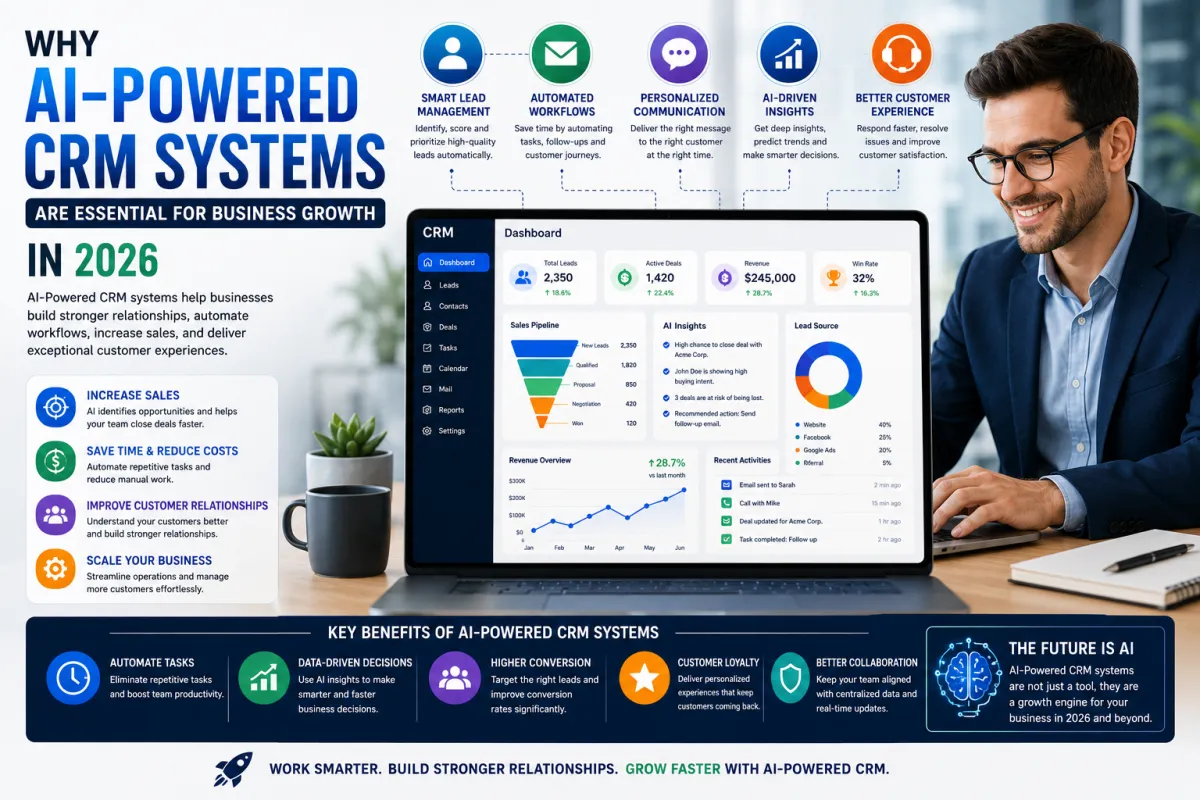
Modern CRM platforms are no longer simple contact databases. They now use artificial intelligence to automate workflows, predict customer behavior, improve sales processes, and enhance customer engagement.
For startups, agencies, SaaS companies, eCommerce stores, healthcare providers, and local businesses, AI-powered CRM systems have become essential tools for sustainable growth and scalability.
In this guide, we will explore why AI-powered CRM systems are critical for business success in 2026 and how they are transforming modern operations.
What Is an AI-Powered CRM System?
An AI-powered CRM system is a customer management platform enhanced with artificial intelligence capabilities.
Unlike traditional CRMs, AI-powered systems can:
-
Analyze customer behavior
-
Automate repetitive tasks
-
Predict sales opportunities
-
Personalize communication
-
Generate business insights
-
Improve customer engagement
These systems help businesses make smarter decisions while reducing manual workload.
Why Businesses Need AI-Powered CRM Systems
Businesses today handle large amounts of customer data from:
-
Websites
-
Social media
-
Email campaigns
-
SMS marketing
-
Phone calls
-
Live chat systems
Managing this information manually is time-consuming and inefficient.
AI-powered CRM systems organize and analyze customer data automatically, helping businesses improve operations and customer relationships.
1. AI CRMs Automate Repetitive Tasks
One of the biggest advantages of AI-powered CRMs is automation.
Businesses can automate tasks such as:
-
Lead assignment
-
Follow-up emails
-
Appointment reminders
-
Data entry
-
Pipeline updates
-
Customer tagging
This reduces manual work and allows teams to focus on high-value activities like sales and strategy.
2. AI CRMs Improve Lead Management
Lead management is essential for business growth.
AI-powered CRM systems can:
-
Track customer behavior
-
Score leads automatically
-
Identify high-intent prospects
-
Prioritize sales opportunities
-
Trigger automated follow-ups
For example, when a potential customer visits a pricing page multiple times, the CRM can alert the sales team immediately.
This improves conversion rates and sales efficiency.
3. AI CRMs Personalize Customer Communication
Customers expect personalized experiences in 2026.
AI-powered CRMs help businesses deliver personalized communication by:
-
Tracking customer preferences
-
Analyzing buying behavior
-
Segmenting audiences automatically
-
Recommending personalized offers
Businesses can send targeted emails, SMS campaigns, and promotions based on customer interests and behavior patterns.
This increases engagement and customer satisfaction.
4. AI CRMs Improve Sales Performance
Sales teams benefit significantly from AI-powered CRM systems.
AI tools can:
-
Predict sales outcomes
-
Recommend next actions
-
Identify upsell opportunities
-
Monitor pipeline health
-
Track customer engagement
This helps sales teams close deals faster and improve overall performance.
5. AI CRMs Enhance Customer Support
Customer support is becoming more important as competition increases.
AI-powered CRMs improve support by:
-
Tracking customer interactions
-
Managing support tickets
-
Automating responses
-
Integrating AI chatbots
-
Providing customer history instantly
Support teams can resolve issues faster and provide better customer experiences.
6. AI CRMs Provide Better Business Insights
Data-driven decision-making is critical for growth.
AI-powered CRM systems analyze large amounts of data and provide insights such as:
-
Best-performing marketing campaigns
-
Customer retention trends
-
Revenue forecasts
-
Customer lifetime value
-
Sales conversion rates
These insights help businesses optimize strategies and improve profitability.
7. AI CRMs Support Marketing Automation
Marketing automation is essential for scaling businesses.
AI-powered CRM systems can:
-
Automate email campaigns
-
Schedule SMS marketing
-
Segment audiences
-
Track campaign performance
-
Trigger personalized workflows
This ensures consistent communication while saving time and resources.
8. AI CRMs Improve Customer Retention
Retaining existing customers is more cost-effective than acquiring new ones.
AI-powered CRM systems improve retention by:
-
Identifying churn risks
-
Sending personalized follow-ups
-
Automating loyalty campaigns
-
Tracking customer satisfaction
Businesses can proactively engage customers before they lose interest.
9. AI CRMs Help Businesses Scale Faster
As businesses grow, managing customer relationships becomes more complex.
AI-powered CRMs make scaling easier by:
-
Automating workflows
-
Organizing customer data
-
Streamlining team collaboration
-
Managing larger sales pipelines
-
Improving operational efficiency
This allows businesses to grow without overwhelming their teams.
10. AI CRMs Enable Omnichannel Communication
Customers interact with businesses through multiple channels, including:
-
Email
-
SMS
-
Social media
-
Live chat
-
Phone calls
AI-powered CRM systems centralize communication across all channels.
This ensures businesses provide consistent customer experiences regardless of where interactions happen.
Popular AI-Powered CRM Platforms in 2026
1. GoHighLevel
An all-in-one platform for marketing agencies and businesses with automation, CRM, and AI tools.
2. HubSpot CRM
Offers AI-powered marketing, sales, and customer service features.
3. Salesforce Einstein
Uses advanced AI capabilities for predictive analytics and automation.
4. Zoho CRM
Provides automation, analytics, and AI-powered sales assistance.
5. Pipedrive AI
Helps businesses manage pipelines and improve sales performance.
Challenges of AI-Powered CRM Systems
Despite their benefits, businesses may face challenges such as:
-
Initial setup complexity
-
Learning curves for teams
-
Integration issues
-
Data privacy concerns
-
Automation errors if workflows are poorly configured
However, proper implementation and training can minimize these challenges.
Best Practices for Implementing AI CRM Systems
To maximize results, businesses should:
-
Start with simple automation workflows
-
Keep customer data organized
-
Train employees properly
-
Monitor automation performance
-
Combine AI with human oversight
-
Continuously optimize processes
This ensures smooth adoption and long-term success.
The Future of AI-Powered CRM Systems
The future of CRM technology is becoming increasingly intelligent.
Future trends include:
-
Fully automated customer journeys
-
Predictive sales forecasting
-
Voice-controlled CRM systems
-
Real-time personalization
-
AI-generated customer insights
-
Advanced conversational AI support
Businesses that adopt AI-powered CRM systems early will gain a major competitive advantage.