White-Label SaaS: A New Revenue Stream for Marketing Agencies in 2026
Table of Contents
-
Introduction
-
What Is White-Label SaaS?
-
How White-Label SaaS Works
-
Why Marketing Agencies Are Adopting White-Label SaaS
-
Benefits of White-Label SaaS
-
Features Clients Expect
-
Building a Recurring Revenue Model
-
Choosing the Right White-Label SaaS Platform
-
Common Challenges and Solutions
-
Best Practices for Long-Term Success
-
Frequently Asked Questions
-
Conclusion
Introduction
Marketing agencies have traditionally generated revenue by offering services such as search engine optimization, social media management, website development, paid advertising, content creation, and email marketing. While these services remain valuable, they often rely on project-based or monthly retainers that require continuous client work to maintain income.
As competition grows, many agencies are looking for ways to diversify their revenue and create more predictable income streams. One of the most effective approaches is offering White-Label Software as a Service (SaaS).
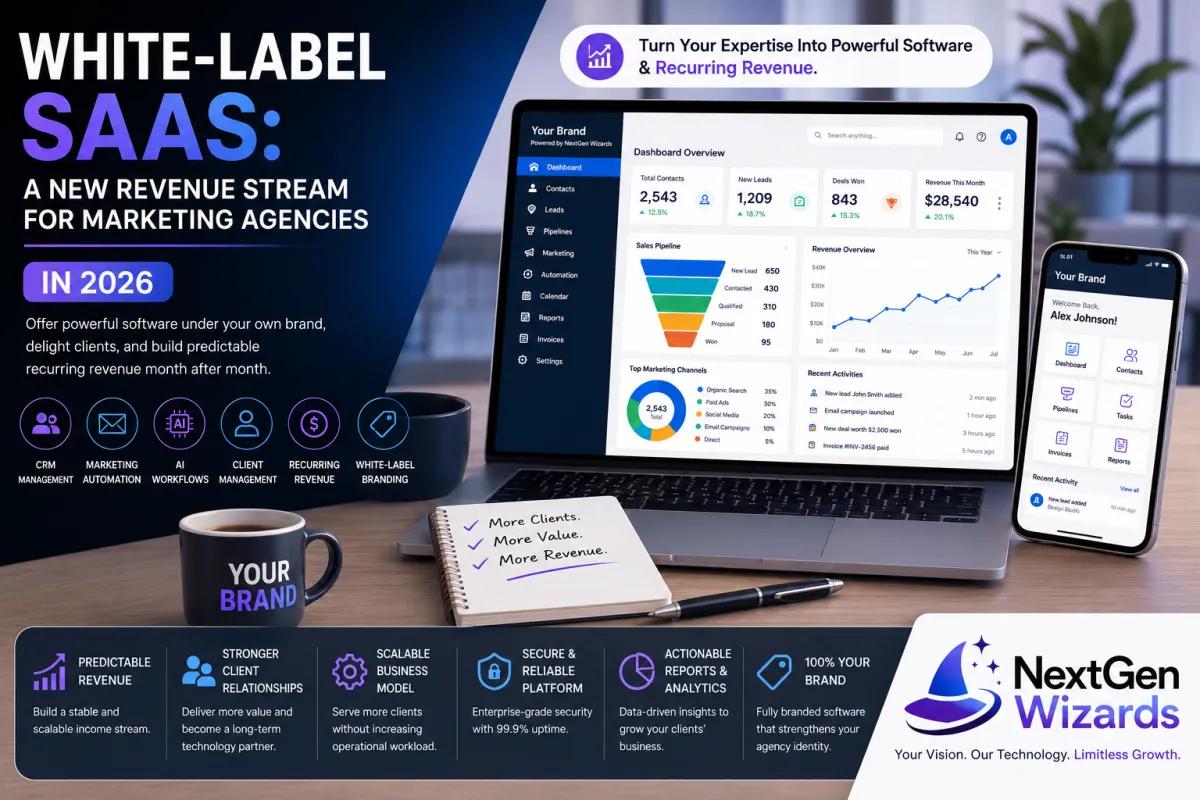
White-label SaaS allows agencies to provide software solutions under their own brand without building the technology from scratch. Instead of developing a CRM, automation platform, or client portal internally, agencies partner with an established software provider and customize the platform with their own branding.
This approach enables agencies to expand their services, strengthen client relationships, and generate recurring monthly revenue while focusing on marketing expertise rather than software development.
What Is White-Label SaaS?
White-label SaaS is software developed by one company but rebranded and sold by another company as its own product.
The software provider maintains the infrastructure, updates, security, and technical development, while the agency customizes the appearance with its own:
-
Logo
-
Business name
-
Brand colors
-
Domain
-
Client portal
To clients, the software appears to be an exclusive solution offered directly by the agency. This business model allows agencies to provide advanced digital tools without investing years in software engineering.
How White-Label SaaS Works
The white-label SaaS model follows a straightforward process. First, the software provider develops and maintains the platform.
Next, the agency customizes the branding and configures services according to its business model. Clients subscribe to the software through the agency rather than purchasing directly from the software developer.
The agency typically manages:
-
Client onboarding
-
Training
-
Billing
-
Customer relationships
-
Ongoing support
Meanwhile, the software provider continues handling:
-
System maintenance
-
Security updates
-
Performance improvements
-
Infrastructure
-
Feature development
This partnership allows agencies to focus on customer success while leveraging enterprise-level technology.
Why Marketing Agencies Are Adopting White-Label SaaS
Agency business models have evolved significantly over the past decade. Clients increasingly expect more than traditional marketing services. They also want technology that helps manage leads, automate communication, schedule appointments, and monitor business performance.
Rather than recommending separate software platforms, agencies can provide an integrated solution under their own brand.
Several factors contribute to the growing popularity of white-label SaaS:
-
Demand for business automation
-
Increased competition among agencies
-
Desire for predictable recurring income
-
Stronger client retention
-
Growing adoption of cloud-based software
Offering software transforms agencies from service providers into long-term technology partners.
Benefits of White-Label SaaS
White-label SaaS offers several advantages for agencies seeking sustainable growth.
Recurring Monthly Revenue
Unlike one-time projects, software subscriptions generate consistent monthly income. Predictable revenue helps agencies improve financial planning and reduce dependence on new client acquisition.
Stronger Client Retention
When clients rely on agency-provided software for daily operations, they are less likely to switch providers. The software becomes integrated into their business processes, creating stronger long-term relationships.
Expanded Service Offerings
Agencies can complement existing services with software solutions that support:
-
Customer relationship management
-
Marketing automation
-
Appointment scheduling
-
Reputation management
-
Reporting
-
Lead management
This creates a more comprehensive service portfolio.
Faster Business Growth
Building proprietary software requires significant investment in development, testing, infrastructure, and ongoing maintenance.
White-label SaaS eliminates these barriers, allowing agencies to launch software solutions much more quickly.
Enhanced Brand Recognition
Every time clients log into the platform, they interact with the agency’s branding rather than a third-party software provider.
Consistent branding strengthens credibility and reinforces long-term customer relationships.
Features Clients Expect
Businesses adopting SaaS platforms expect more than simple contact management.
Modern clients typically look for features such as:
-
Customer relationship management
-
Sales pipelines
-
Marketing automation
-
Email campaigns
-
SMS communication
-
Appointment scheduling
-
Online forms
-
Workflow automation
-
Team collaboration
-
Reporting dashboards
-
Mobile accessibility
-
Contact management
-
Calendar integration
-
Lead tracking
-
Customer communication history
Providing these capabilities through one platform increases the overall value delivered to clients.
Building a Recurring Revenue Model
One of the biggest advantages of white-label SaaS is its subscription-based business model. Instead of relying solely on project income, agencies generate ongoing monthly revenue through software subscriptions.
Many agencies organize their offerings into different service levels. A basic plan may include essential CRM features and contact management.
A professional plan might add workflow automation, appointment scheduling, reporting, and advanced communication tools. An enterprise plan could include additional customization, advanced automation, multiple user accounts, and expanded business management capabilities. Offering multiple subscription levels allows agencies to serve businesses with different operational requirements while creating opportunities for long-term account growth.
Choosing the Right White-Label SaaS Platform
Selecting the right software platform is one of the most important decisions an agency can make. Several factors should be considered before adopting any white-label solution.
Reliability
The platform should provide stable performance and minimal downtime. Reliable software supports better client experiences.
Scalability
As agencies acquire more clients, the platform should continue performing efficiently without significant limitations.
Security
Business software often stores sensitive customer information. Strong security measures help protect client data and maintain trust.
Customization
The platform should allow agencies to fully customize branding and configure services according to their business model.
Automation
Businesses increasingly expect automation features that reduce manual work and improve operational efficiency.
Common Challenges and Solutions
Although white-label SaaS offers many benefits, agencies should prepare for potential challenges.
Client Onboarding
Some customers require additional guidance when adopting new software. Providing structured onboarding helps improve user confidence.
Feature Overload
Modern SaaS platforms often include numerous tools. Introducing features gradually allows clients to learn the platform more effectively.
Ongoing Support
Clients may occasionally need technical assistance or workflow guidance. Establishing clear support processes improves customer satisfaction.
User Adoption
Encouraging consistent software usage is essential for long-term retention. Training resources and regular check-ins help clients maximize platform value.
Best Practices for Long-Term Success
Agencies can improve the success of their white-label SaaS offering by following several best practices.
-
Maintain consistent branding across the platform.
-
Provide clear onboarding materials.
-
Offer practical training sessions.
-
Collect customer feedback regularly.
-
Monitor software usage and engagement.
-
Keep clients informed about new features.
-
Review customer needs periodically and adjust service offerings as businesses grow.
-
Focusing on customer success encourages long-term relationships and sustainable recurring revenue.
Frequently Asked Questions
What is white-label SaaS?
White-label SaaS is software developed by one company and rebranded by another business to be sold under its own name and branding.
Why are marketing agencies adopting white-label SaaS?
Agencies use white-label SaaS to generate recurring monthly revenue, strengthen client relationships, expand service offerings, and provide business software without developing their own platform.
Can agencies customize white-label SaaS?
Yes. Most white-label platforms allow agencies to customize logos, colors, domains, client portals, and other branding elements.
What types of businesses use white-label SaaS?
Marketing agencies, consultants, coaches, healthcare providers, real estate firms, financial advisors, legal practices, and many service-based businesses use white-label SaaS solutions.
Is white-label SaaS suitable for small agencies?
Yes. Small agencies can use white-label SaaS to expand their services, improve client retention, and build predictable recurring revenue without significant software development costs.
Conclusion
White-label SaaS has become a valuable growth strategy for marketing agencies seeking to diversify revenue and strengthen client relationships. By offering branded software solutions, agencies can provide clients with tools for customer management, automation, communication, and business operations while creating predictable recurring income. Because the software provider manages development, security, and infrastructure, agencies can focus on delivering exceptional customer experiences and expanding their service offerings. As demand for integrated digital solutions continues to grow, white-label SaaS provides agencies with an efficient way to increase long-term value, improve client retention, and build a more scalable business model.