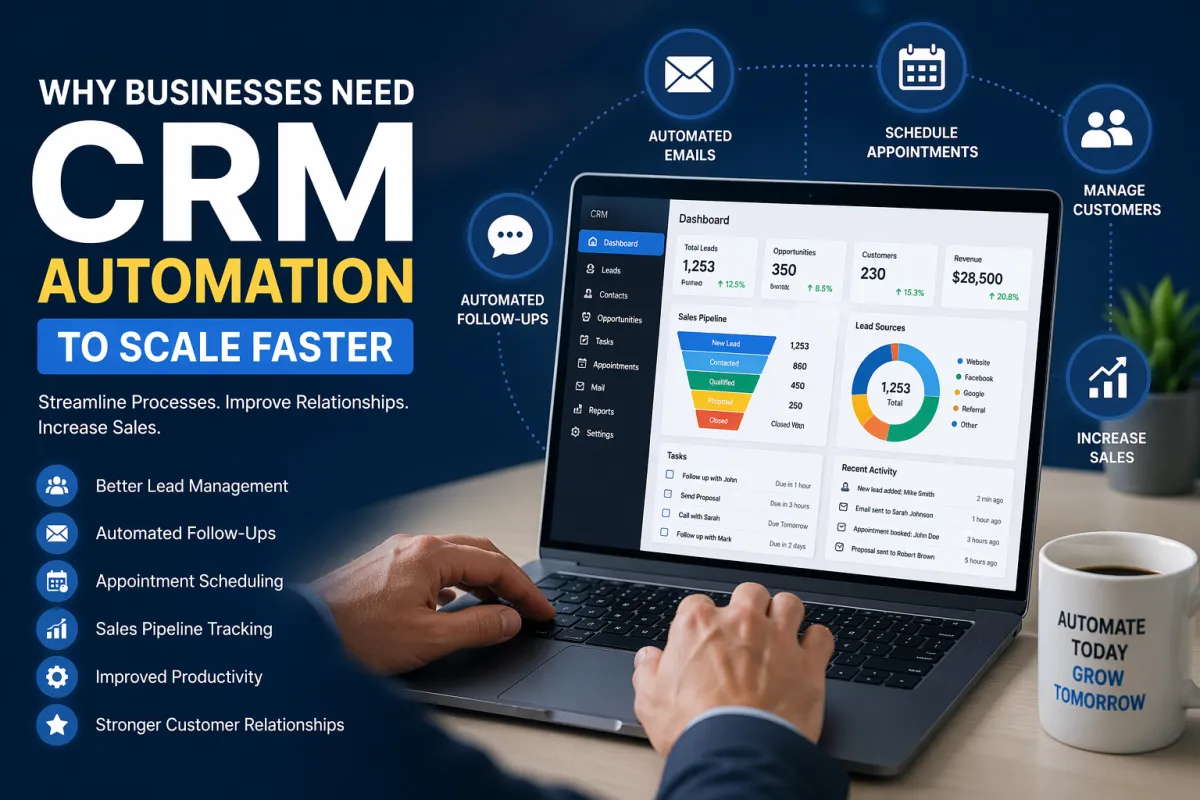
Why Businesses Need CRM Automation to Scale Faster
Why Businesses Need CRM Automation to Scale Faster
In 2026, businesses face more competition, higher customer expectations, and increasing pressure to improve efficiency. Whether you run a startup, local business, eCommerce store, agency, real estate company, or service-based business, managing leads and customer relationships manually can slow growth.
As businesses expand, the number of leads, customers, appointments, emails, follow-ups, and sales opportunities also increases. Without a proper system in place, it becomes difficult to keep track of every interaction, respond quickly, and maintain a consistent customer experience.
This is why CRM automation has become essential for businesses that want to scale faster.
CRM automation helps companies organize customer data, automate repetitive tasks, improve communication, and increase conversions. Instead of relying on spreadsheets, sticky notes, or disconnected tools, businesses can use CRM systems to manage the entire customer journey from one place.
In this article, we will explore why businesses need CRM automation, how it improves efficiency, and why it is one of the smartest investments for long-term growth.
What Is CRM Automation?
CRM stands for Customer Relationship Management.
CRM automation refers to the use of software to automate tasks related to customer communication, lead tracking, sales management, and follow-ups.
Instead of manually entering customer information, sending individual emails, or remembering to follow up with leads, CRM automation handles these tasks automatically.
A CRM system can automate:
Lead capture
Contact management
Follow-up emails
SMS reminders
Appointment scheduling
Sales pipeline updates
Task assignments
Customer segmentation
Reporting and analytics
Customer support communication
CRM automation allows businesses to focus more on strategy, sales, and customer service instead of repetitive manual work.
Why Manual Customer Management Slows Business Growth
Many businesses still rely on manual processes to manage customer relationships.
They use spreadsheets, notebooks, email inboxes, and different apps to track leads and sales.
While this may work for a small number of customers, it becomes difficult as the business grows.
Manual customer management often leads to:
Missed leads
Delayed follow-ups
Poor communication
Human error
Lost customer data
Inconsistent sales processes
Low productivity
Difficulty tracking customer history
These problems can reduce customer satisfaction, lower conversion rates, and make it harder for businesses to scale.
CRM automation solves these challenges by creating a centralized system for all customer interactions.
How CRM Automation Helps Businesses Scale Faster
1. Faster Lead Response Times
Speed matters when responding to leads.
Studies show that businesses that contact leads quickly are more likely to convert them into customers.
CRM automation allows businesses to instantly:
Send welcome emails
Deliver SMS responses
Notify sales teams
Assign leads to the right employee
Schedule follow-up tasks
This ensures that leads receive immediate attention, even outside normal business hours.
Faster response times improve customer experience and increase the chances of closing sales.
2. Better Lead Management
As businesses grow, managing large numbers of leads becomes more challenging.
Without a CRM, it is easy to lose track of who has been contacted, which leads are ready to buy, and who needs follow-up.
CRM automation helps businesses organize leads by:
Tracking lead sources
Assigning lead scores
Segmenting contacts
Moving leads through the sales pipeline
Prioritizing high-value opportunities
This makes it easier for sales teams to focus on the most promising leads and close more deals.
3. Automated Follow-Ups
Many sales are lost because businesses fail to follow up consistently.
Potential customers often need multiple interactions before making a decision.
CRM automation ensures that no lead is forgotten by automatically sending:
Follow-up emails
SMS reminders
Appointment confirmations
Promotional offers
Review requests
Re-engagement campaigns
Businesses can create workflows that trigger follow-ups based on customer actions.
For example, if someone downloads a guide, books a consultation, or abandons a shopping cart, the CRM can automatically send a personalized message.
4. Centralized Customer Information
When customer information is scattered across emails, spreadsheets, notes, and multiple apps, it becomes difficult to provide good service.
CRM systems keep all customer data in one place, including:
Contact details
Purchase history
Appointment records
Communication history
Notes and preferences
Previous support requests
Having centralized data helps businesses better understand customer behavior and provide more personalized experiences.
5. Improved Team Productivity
Manual tasks can consume a lot of time.
Employees often spend hours updating spreadsheets, sending emails, scheduling appointments, and entering customer information.
CRM automation reduces these repetitive tasks and allows teams to focus on more valuable activities such as:
Closing sales
Building customer relationships
Solving customer problems
Creating marketing campaigns
Growing the business
By reducing manual work, businesses can achieve more without increasing staff costs.
6. Better Customer Experience
Customers expect fast responses, personalized communication, and consistent service.
CRM automation helps businesses deliver a better customer experience by:
Responding quickly to inquiries
Sending personalized messages
Tracking customer preferences
Providing consistent follow-up
Reducing mistakes
A better customer experience leads to higher satisfaction, stronger loyalty, and more repeat business.
7. Stronger Sales Pipeline Management
A CRM system gives businesses a clear view of their sales pipeline.
This allows teams to see:
Which leads are new
Which leads need follow-up
Which deals are close to closing
Which opportunities are stalled
Which customers need additional support
Sales pipeline visibility helps businesses make better decisions and forecast future revenue more accurately.
CRM Automation for Different Types of Businesses
Small Businesses
Small businesses often have limited staff and resources.
CRM automation helps them stay organized, respond faster, and compete with larger companies.
Small businesses can use CRM automation for:
Lead tracking
Appointment booking
Email marketing
Customer follow-ups
Review requests
Marketing Agencies
Agencies can use CRM automation to manage client communication, track leads, automate onboarding, and monitor campaign performance.
This allows agencies to handle more clients without increasing workload.
Real Estate Businesses
Real estate agents need to follow up with leads quickly and consistently.
CRM automation helps them manage property inquiries, schedule showings, and stay connected with buyers and sellers.
Healthcare Providers
Healthcare businesses can automate appointment reminders, patient follow-ups, review requests, and communication.
This reduces missed appointments and improves patient satisfaction.
eCommerce Stores
Online stores can use CRM automation to recover abandoned carts, send order updates, recommend products, and encourage repeat purchases.
Key Features to Look for in a CRM Automation System
Not all CRM systems offer the same features.
Businesses should look for a CRM platform that includes:
Contact management
Sales pipeline tracking
Workflow automation
Email and SMS marketing
Appointment scheduling
Reporting and analytics
Lead scoring
Customer segmentation
Mobile access
Third-party integrations
The right CRM should be easy to use, scalable, and flexible enough to support business growth.
CRM Automation vs Traditional Customer Management
Traditional customer management relies heavily on manual work and disconnected systems.
Businesses may use:
Spreadsheets
Paper notes
Separate email tools
Multiple software platforms
Manual reminders
This often creates inefficiencies and makes it difficult to scale.
CRM automation offers a more organized and efficient solution.
Compared to manual systems, CRM automation provides:
Faster communication
Better organization
More accurate customer data
Stronger reporting
Higher productivity
Better lead conversion
Improved customer retention
Businesses that continue relying on manual processes may struggle to compete in the future.
Common Signs Your Business Needs CRM Automation
If your business experiences any of the following problems, it may be time to invest in CRM automation:
You forget to follow up with leads
Your team uses spreadsheets to track customers
Customer information is scattered across different systems
You struggle to respond quickly to inquiries
You have difficulty tracking sales performance
Your business is growing faster than your current systems can handle
Customers complain about poor communication
CRM automation can help solve these problems and create a more scalable business model.
The Future of CRM Automation in 2026
CRM systems are becoming more advanced every year.
In 2026, CRM platforms are expected to include more artificial intelligence, predictive analytics, chatbots, voice automation, and customer behavior tracking.
These technologies will help businesses:
Predict customer needs
Personalize communication
Improve sales forecasting
Reduce customer churn
Increase efficiency
Businesses that adopt CRM automation early will be better positioned to stay ahead of competitors.

