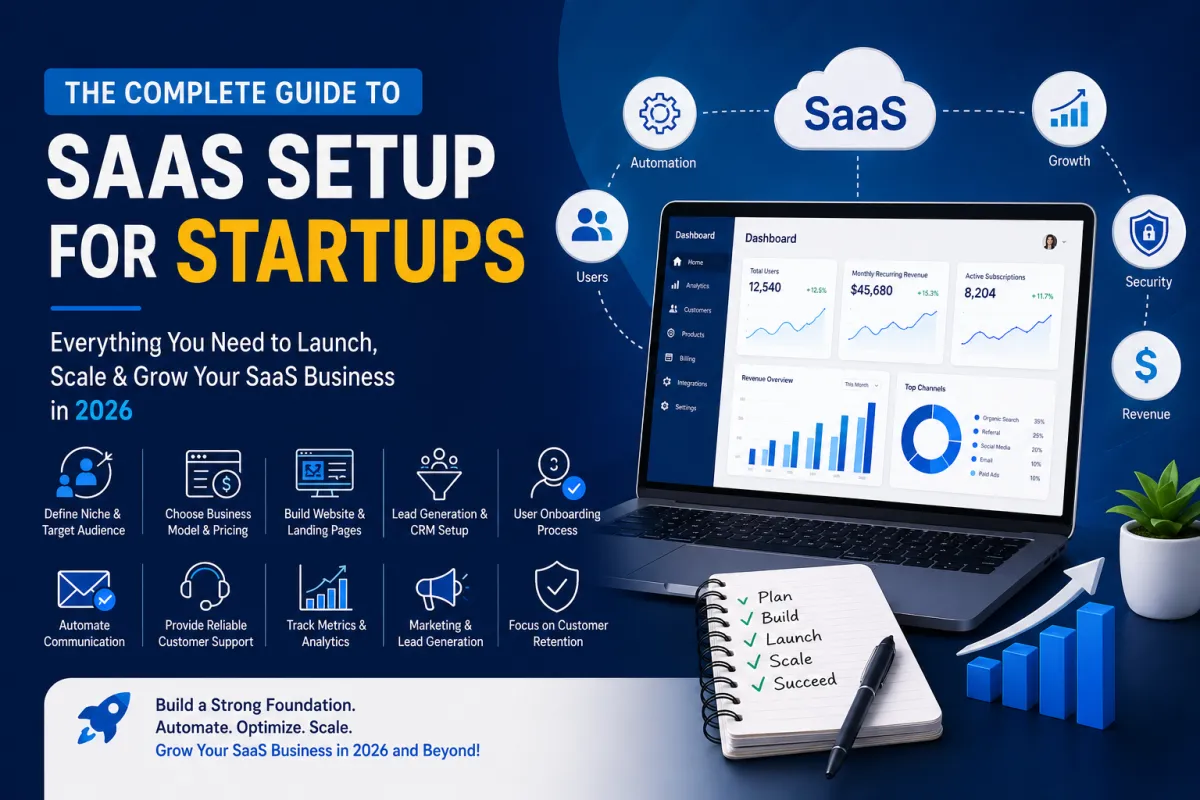
The Complete Guide to SaaS Setup for Startups
Starting a Software as a Service (SaaS) business in 2026 offers enormous opportunities. With more companies moving online, demand for cloud based software solutions continues to grow across industries such as marketing, healthcare, finance, eCommerce, education, and customer support.
However, building a successful SaaS startup requires more than just a great software idea. Founders need the right setup, systems, tools, automation, pricing strategy, customer support, and marketing plan to create a scalable business.
Without the proper SaaS setup, startups often struggle with poor user onboarding, weak customer retention, slow growth, and operational inefficiencies.
This guide explains everything startups need to know about setting up a SaaS business for long-term success.
What Is a SaaS Business?
SaaS stands for Software as a Service.
A SaaS business provides software through the internet instead of requiring customers to install it on their computers.
Users typically pay a monthly or yearly subscription fee to access the platform.
Popular SaaS examples include:
-
Customer relationship management tools
-
Project management software
-
Email marketing platforms
-
Accounting software
-
Video conferencing tools
-
eCommerce platforms
-
Marketing automation software
The SaaS model is attractive because it provides recurring revenue, predictable cash flow, and scalability.
Why Proper SaaS Setup Matters
Many startups focus heavily on product development but overlook important business systems.
A poor setup can lead to:
-
Confusing user onboarding
-
Low trial-to-paid conversion rates
-
High customer churn
-
Poor customer support
-
Inconsistent billing
-
Weak marketing performance
-
Lost leads
-
Slow business growth
A strong SaaS setup helps startups:
-
Improve customer experiences
-
Increase recurring revenue
-
Streamline operations
-
Automate repetitive tasks
-
Track performance metrics
-
Scale more efficiently
1. Define Your SaaS Niche and Target Audience
Before building your SaaS product, you need to clearly define who you serve.
The most successful SaaS businesses solve a specific problem for a specific audience.
For example, your SaaS product may target:
-
Marketing agencies
-
Real estate businesses
-
Dentists and healthcare clinics
-
eCommerce stores
-
Coaches and consultants
-
Restaurants
-
Fitness businesses
-
Small business owners
Understanding your target audience helps you create the right features, messaging, pricing, and marketing strategy.
Important questions to ask include:
-
What problem does the software solve?
-
Who experiences this problem?
-
How are customers solving it today?
-
Why is your solution better?
-
What features matter most to your audience?
2. Choose the Right SaaS Business Model
There are several SaaS pricing and business models to choose from.
The right model depends on your audience, industry, and product value.
Common SaaS pricing models include:
Monthly Subscription
Customers pay a fixed monthly fee.
This is the most common SaaS pricing structure.
Annual Subscription
Customers pay once per year, often at a discounted rate.
Annual plans improve cash flow and customer retention.
Freemium Model
Users get access to a limited free version of the software.
Additional features require a paid upgrade.
Usage-Based Pricing
Customers pay based on how much they use the software.
Examples include the number of users, contacts, messages, or transactions.
Tiered Pricing
Different pricing levels offer different features and usage limits.
This model helps startups serve both small and large customers.
3. Build a User-Friendly Website and Landing Pages
Your website is one of the most important parts of your SaaS setup.
It should clearly explain:
-
What your software does
-
Who it is for
-
The key benefits
-
Pricing options
-
Product features
-
Customer reviews
-
Frequently asked questions
-
How to get started
Your website should also include dedicated landing pages for:
-
Free trials
-
Demo bookings
-
Product features
-
Industry-specific use cases
-
Pricing comparisons
-
Integrations
A clear and well-designed website can significantly improve conversions.
4. Set Up CRM and Lead Management Systems
Lead generation is essential for SaaS growth.
Startups need a CRM system to manage:
-
Trial signups
-
Demo requests
-
Customer inquiries
-
Follow-up sequences
-
Sales pipelines
-
Customer interactions
CRM tools help startups stay organized and ensure no leads are lost.
Popular CRM options for SaaS startups include GoHighLevel, HubSpot, Salesforce, Zoho CRM, and Pipedrive.
CRM automation can also improve:
-
Lead nurturing
-
Email campaigns
-
Appointment scheduling
-
Customer onboarding
-
Sales follow-ups
5. Create a Strong User Onboarding Process
One of the biggest reasons SaaS startups fail is poor onboarding.
If users do not understand how to use the software quickly, they may cancel before becoming paying customers.
A strong onboarding process should include:
-
Welcome emails
-
Step-by-step tutorials
-
Video walkthroughs
-
Product tours
-
Live demos
-
Setup checklists
-
Knowledge base articles
-
Customer support options
The goal is to help users achieve success as quickly as possible.
The faster customers see value, the more likely they are to stay.
6. Automate Customer Communication
Customer communication is critical for SaaS businesses.
Startups should automate communication through:
-
Email marketing
-
SMS reminders
-
In-app notifications
-
Chatbots
-
Push notifications
-
Follow-up campaigns
Examples of automated communication include:
-
Trial expiration reminders
-
Feature announcements
-
Renewal reminders
-
Upsell opportunities
-
Customer satisfaction surveys
-
Re-engagement campaigns
Automation improves consistency and reduces manual work.
7. Offer Reliable Customer Support
Customer support can have a major impact on retention and reputation.
SaaS startups should provide multiple support channels such as:
-
Live chat
-
Email support
-
Help desk systems
-
Knowledge bases
-
Video tutorials
-
Community forums
-
Phone support
Fast and helpful support improves customer satisfaction and reduces churn.
AI chatbots can also help answer common questions and provide 24/7 assistance.
8. Track Important SaaS Metrics
Data is essential for SaaS growth.
Startups should monitor key performance indicators such as:
-
Monthly recurring revenue
-
Annual recurring revenue
-
Customer acquisition cost
-
Customer lifetime value
-
Churn rate
-
Trial-to-paid conversion rate
-
Average revenue per user
-
Net promoter score
-
Website conversion rate
Tracking these metrics helps startups identify strengths, weaknesses, and opportunities for improvement.
9. Invest in Marketing and Lead Generation
Even the best SaaS product will struggle without strong marketing.
Startups should invest in multiple lead generation channels such as:
-
SEO
-
Content marketing
-
Paid ads
-
Social media marketing
-
Email campaigns
-
Influencer partnerships
-
Referral programs
-
Affiliate marketing
-
Webinars
-
Video marketing
Content marketing is especially valuable because it helps attract organic traffic over time.
Blog topics can include:
-
Industry trends
-
How-to guides
-
Product comparisons
-
Customer success stories
-
Problem-solving content
10. Focus on Customer Retention
Acquiring customers is important, but retaining them is even more valuable.
High churn rates can hurt SaaS growth.
To improve retention, startups should:
-
Provide excellent onboarding
-
Offer strong customer support
-
Send regular product updates
-
Collect customer feedback
-
Personalize communication
-
Reward loyal customers
-
Improve product usability
Retaining existing customers is often less expensive than acquiring new ones.
11. Build Scalable Internal Systems
As the startup grows, operations become more complex.
Businesses should build systems that can scale over time.
This includes:
-
Automated billing
-
CRM workflows
-
Team collaboration tools
-
Standard operating procedures
-
Customer support systems
-
Reporting dashboards
Scalable systems help startups grow without creating operational chaos.
Common SaaS Setup Mistakes to Avoid
Many startups make avoidable mistakes during setup.
Some common SaaS mistakes include:
-
Targeting too broad of an audience
-
Poor onboarding experiences
-
Weak pricing strategies
-
Ignoring customer feedback
-
Failing to track metrics
-
Overcomplicating the product
-
Underinvesting in marketing
-
Neglecting customer support
Avoiding these mistakes can improve growth and profitability.
The Future of SaaS in 2026
The SaaS industry is evolving rapidly.
In 2026, SaaS businesses are expected to invest more in:
-
Artificial intelligence
-
Predictive analytics
-
Voice automation
-
Personalization
-
No-code tools
-
Workflow automation
-
Advanced security
-
Mobile-first experiences
Businesses that adapt to these trends will have a stronger advantage in the market.