How to Create High-Converting Sales Funnels That Drive More Leads
In 2026, businesses cannot rely on random website traffic or generic marketing campaigns to generate consistent leads. Customers have more options than ever before, shorter attention spans, and higher expectations.
To turn visitors into leads and leads into paying customers, businesses need a clear and structured process. This is where sales funnels become essential.
A high-converting sales funnel guides potential customers through every stage of the buying journey, from initial awareness to final purchase.
Whether you run a marketing agency, SaaS business, real estate company, eCommerce store, healthcare clinic, coaching business, or local service company, a strong sales funnel can help you generate more leads, improve conversions, and increase revenue.
In this guide, we will explain how to create high-converting sales funnels that drive more leads and help your business grow in 2026.
What Is a Sales Funnel?
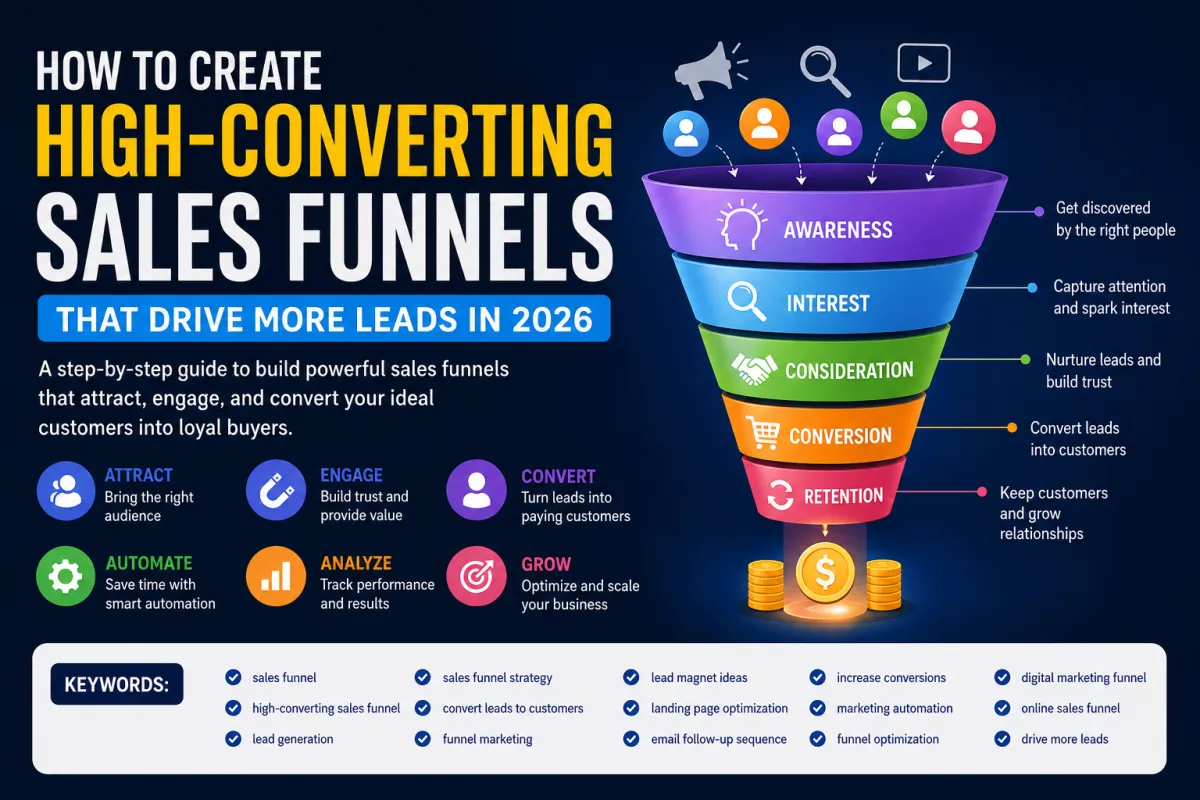
A sales funnel is a step-by-step process that moves potential customers from the first interaction with your business to becoming a paying customer.
It is called a funnel because many people enter at the top, but only a smaller percentage move through each stage and make a purchase.
A typical sales funnel includes:
-
Awareness
-
Interest
-
Consideration
-
Conversion
-
Retention
Each stage requires different messaging, offers, and follow-up strategies.
Why Sales Funnels Matter in 2026
Many businesses lose potential customers because they do not have a structured follow-up process.
Without a funnel, leads may:
-
Visit your website and leave
-
Forget about your business
-
Get distracted by competitors
-
Delay making a decision
-
Lose interest
A sales funnel helps businesses:
-
Capture leads
-
Build trust
-
Educate potential customers
-
Increase conversions
-
Automate follow-ups
-
Improve customer retention
Funnels also help businesses track performance and identify where leads are dropping off.
Step 1: Understand Your Target Audience
Before creating a funnel, you need to understand who you are targeting.
A successful sales funnel speaks directly to the needs, problems, and goals of your audience.
Ask questions such as:
-
Who is your ideal customer?
-
What problem are they trying to solve?
-
What challenges do they face?
-
What motivates them to buy?
-
What objections might they have?
For example, a real estate business may target first-time homebuyers, while a SaaS company may target small business owners looking for automation.
The more you understand your audience, the easier it becomes to create messaging that converts.
Step 2: Create a Strong Lead Magnet
A lead magnet is something valuable that you offer in exchange for contact information.
Lead magnets help attract visitors and encourage them to enter your funnel.
Popular lead magnet ideas include:
-
Free guides
-
eBooks
-
Checklists
-
Templates
-
Free trials
-
Webinars
-
Discount codes
-
Free consultations
-
Case studies
-
Product demos
Your lead magnet should solve a specific problem and provide immediate value.
For example, a marketing agency could offer a free SEO audit, while a fitness business could offer a meal plan guide.
Step 3: Build a High-Converting Landing Page
The landing page is one of the most important parts of the funnel.
Its job is to convince visitors to take action.
A strong landing page should include:
-
A clear headline
-
A strong value proposition
-
A brief explanation of the offer
-
Customer testimonials
-
Social proof
-
A call-to-action button
-
A simple lead capture form
Landing pages should be focused on one goal.
Too many distractions, links, or options can reduce conversions.
Step 4: Use a Simple and Effective Lead Capture Form
The lead capture form should collect only the most important information.
Asking for too much information can reduce conversion rates.
In most cases, it is best to ask for:
-
Name
-
Email address
-
Phone number
Depending on the business, you may also ask about:
-
Company name
-
Industry
-
Budget
-
Service interest
Keep the form simple and easy to complete.
Step 5: Create an Automated Follow-Up Sequence
Most leads do not convert immediately.
This is why follow-up is so important.
After someone enters your funnel, you should automatically send a series of messages to keep them engaged.
An effective follow-up sequence may include:
-
Welcome email
-
Educational content
-
Customer testimonials
-
Case studies
-
Product benefits
-
Appointment booking links
-
Limited-time offers
-
Reminder messages
Businesses can use email, SMS, and retargeting ads to nurture leads.
The goal is to build trust and guide leads toward a purchase.
Step 6: Use Social Proof to Build Trust
People are more likely to buy when they see proof that others have had a positive experience.
Adding social proof to your funnel can significantly improve conversions.
Examples of social proof include:
-
Customer reviews
-
Testimonials
-
Case studies
-
Success stories
-
Before-and-after results
-
Star ratings
-
Video testimonials
Social proof reduces risk and helps potential customers feel more confident.
Step 7: Add Urgency and Scarcity
Many people delay making decisions.
Urgency and scarcity encourage people to take action sooner.
Examples include:
-
Limited-time discounts
-
Countdown timers
-
Limited spots available
-
Expiring bonuses
-
Early bird pricing
However, urgency should be genuine.
Fake scarcity can damage trust.
Step 8: Use Multiple Traffic Sources
A sales funnel needs traffic to generate leads.
Businesses can drive traffic from:
-
SEO
-
Google Ads
-
Facebook Ads
-
Instagram Ads
-
LinkedIn Ads
-
YouTube marketing
-
Email campaigns
-
Social media content
-
Influencer partnerships
-
Referral programs
Using multiple traffic sources helps businesses reach more potential customers.
Step 9: Track Funnel Performance
To improve conversions, businesses need to track how the funnel performs.
Important funnel metrics include:
-
Landing page conversion rate
-
Cost per lead
-
Email open rate
-
Click-through rate
-
Appointment booking rate
-
Sales conversion rate
-
Customer acquisition cost
-
Return on ad spend
By reviewing these numbers, businesses can identify weak areas and make improvements.
Step 10: Test and Optimize Your Funnel
Even a good sales funnel can become better.
Businesses should regularly test different parts of the funnel, such as:
-
Headlines
-
Call-to-action buttons
-
Landing page designs
-
Form length
-
Email subject lines
-
Offer types
-
Images and videos
Small changes can lead to major improvements in conversion rates.
A/B testing helps businesses discover what works best.
Common Sales Funnel Mistakes to Avoid
Many businesses struggle with funnels because they make common mistakes.
These mistakes include:
-
Weak offers
-
Confusing landing pages
-
Poor follow-up
-
Asking for too much information
-
Ignoring mobile users
-
Failing to build trust
-
Not testing funnel performance
-
Driving low-quality traffic
Avoiding these mistakes can improve lead quality and increase sales.
Sales Funnels for Different Industries
Marketing Agencies
Agencies can use funnels to generate leads for SEO, PPC, web design, and automation services.
Real Estate Businesses
Real estate funnels can promote free home valuations, property guides, and buyer consultations.
Healthcare Clinics
Healthcare businesses can use funnels to book consultations, promote treatments, and collect patient information.
SaaS Businesses
SaaS companies often use funnels for free trials, demos, and product onboarding.
eCommerce Stores
Online stores can use funnels for abandoned cart recovery, upsells, and product recommendations.
The Future of Sales Funnels in 2026
Sales funnels are becoming more advanced.
In 2026, businesses are expected to use:
-
AI-powered personalization
-
Chatbot lead capture
-
Predictive analytics
-
Interactive content
-
Video funnels
-
Voice search optimization
-
Multi-channel automation
Businesses that embrace these trends will be more successful at attracting and converting leads.