Common CRM Mistakes That Cost Businesses Customers in 2026
Table of Contents
-
Introduction
-
Why CRM Success Depends on Proper Management
-
Mistake 1: Poor Data Quality
-
Mistake 2: Ignoring Customer Follow-Ups
-
Mistake 3: Not Automating Repetitive Tasks
-
Mistake 4: Poor Team Adoption
-
Mistake 5: Complicated Sales Pipelines
-
Mistake 6: Failing to Track Customer Interactions
-
Mistake 7: Not Using Reports and Analytics
-
Mistake 8: Ignoring Customer Segmentation
-
Mistake 9: Neglecting CRM Maintenance
-
Mistake 10: Choosing the Wrong CRM Strategy
-
Frequently Asked Questions
-
Conclusion
Introduction
A Customer Relationship Management (CRM) system is one of the most valuable tools a business can invest in. It helps organize customer information, manage leads, automate communication, and improve sales performance. However, simply purchasing a CRM does not guarantee better results.
Many businesses fail to realize the full value of their CRM because of poor implementation, inconsistent data management, or ineffective business processes. These mistakes often lead to missed sales opportunities, poor customer experiences, and reduced productivity.
A CRM should simplify customer management, not create additional complexity. When used correctly, it becomes a central hub that supports sales, marketing, customer service, and business growth.
Understanding the most common CRM mistakes allows businesses to identify weaknesses, improve internal processes, and maximize the value of their CRM investment.
Why CRM Success Depends on Proper Management
A CRM stores valuable customer information, but its effectiveness depends entirely on how employees use it. If customer records are incomplete, sales pipelines are outdated, or follow-ups are forgotten, the CRM quickly loses its value.
Successful CRM management requires:
-
Accurate customer information
-
Consistent updates
-
Clear sales processes
-
Team collaboration
-
Automation where appropriate
-
Regular performance reviews
Businesses that treat their CRM as an active business tool rather than a simple contact database achieve significantly better results.
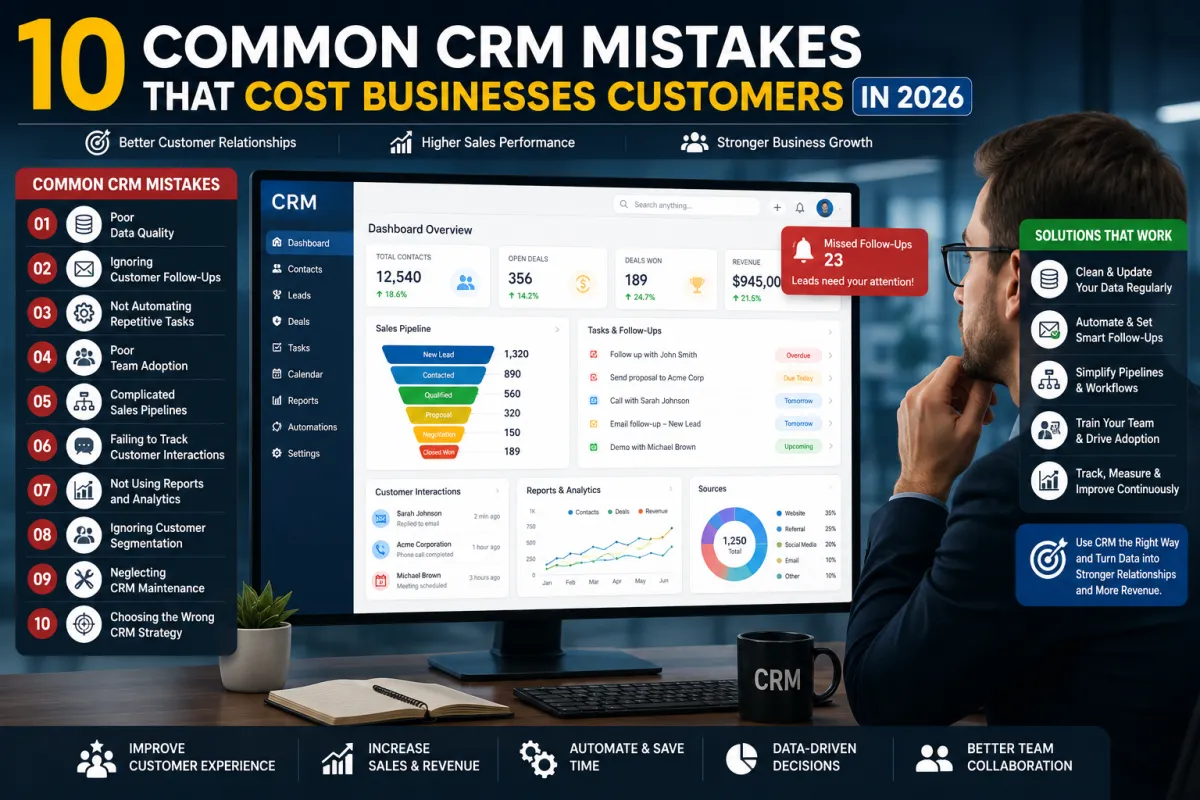
Mistake 1: Poor Data Quality
One of the most common CRM problems is inaccurate or incomplete customer data. Employees may enter information differently, create duplicate contacts, or leave important fields blank.
Examples include:
-
Incorrect phone numbers
-
Misspelled names
-
Duplicate customer records
-
Missing email addresses
-
Outdated contact information
Poor data quality affects reporting, automation, and customer communication. Businesses should regularly clean their CRM by removing duplicates, updating outdated information, and establishing consistent data entry standards.
Mistake 2: Ignoring Customer Follow-Ups
Many businesses lose potential customers simply because they fail to follow up. Prospects who request information often expect a prompt response. Delayed communication creates the impression that the business is disorganized or uninterested.
A CRM should help schedule and track follow-up activities.
Businesses can improve follow-up consistency by:
-
Creating reminder tasks
-
Scheduling follow-up calls
-
Automating email responses
-
Sending appointment confirmations
-
Tracking customer conversations
Consistent follow-up builds trust and increases conversion opportunities.
Mistake 3: Not Automating Repetitive Tasks
Many daily business activities do not require manual effort.Tasks such as appointment reminders, welcome emails, payment notifications, and customer onboarding can often be automated. Without automation, employees spend unnecessary time on repetitive administrative work.
Automation improves efficiency by:
-
Reducing manual data entry
-
Sending timely reminders
-
Managing customer communication
-
Updating sales pipelines
-
Assigning tasks automatically
Businesses that automate routine processes often improve productivity while providing faster customer service.
Mistake 4: Poor Team Adoption
Even the most advanced CRM provides little value if employees do not use it consistently.
Common reasons for poor adoption include:
-
Limited training
-
Complicated workflows
-
Lack of management support
-
Inconsistent processes
-
Resistance to change
Employees should understand how the CRM benefits both the business and their daily work. Providing practical training and encouraging regular usage helps create long-term adoption. Management should also lead by example by actively using CRM reports and customer information during decision-making.
Mistake 5: Complicated Sales Pipelines
A sales pipeline should simplify opportunity management. Some businesses create unnecessary pipeline stages that confuse employees rather than improving organization.
An effective pipeline should clearly represent the customer journey.
Typical stages include:
-
New Lead
-
Contacted
-
Qualified
-
Meeting Scheduled
-
Proposal Sent
-
Negotiation
-
Closed Won
-
Closed Lost
Keeping the pipeline simple allows sales representatives to update opportunities quickly while giving managers accurate visibility into sales performance.
Mistake 6: Failing to Track Customer Interactions
Every customer interaction provides valuable information. Phone calls, emails, meetings, support requests, and previous purchases help employees understand customer needs. Without proper documentation, team members may repeat questions or overlook important details.
Tracking customer interactions helps businesses:
-
Personalize communication
-
Improve customer service
-
Reduce misunderstandings
-
Maintain continuity across teams
-
Build stronger relationships
Complete customer histories allow employees to provide more informed and professional support.
Mistake 7: Not Using Reports and Analytics
Many businesses collect large amounts of CRM data but rarely analyze it. Reporting provides valuable insights into sales performance, customer behavior, and operational efficiency.
Useful metrics include:
-
Lead conversion rate
-
Sales revenue
-
Pipeline value
-
Customer retention
-
Response times
-
Appointment completion
-
Marketing performance
Regularly reviewing these reports helps identify areas for improvement and supports better business decisions. Ignoring analytics often means missing opportunities to optimize processes and increase profitability.
Mistake 8: Ignoring Customer Segmentation
Not every customer has the same needs. Sending identical messages to every contact often reduces engagement.Customer segmentation allows businesses to organize contacts based on characteristics such as:
-
Industry
-
Location
-
Purchase history
-
Customer status
-
Service interests
-
Buying behavior
Segmenting customers makes communication more relevant and improves marketing effectiveness. Personalized communication generally produces better customer experiences than generic messaging.
Mistake 9: Neglecting CRM Maintenance
A CRM requires ongoing maintenance. Businesses sometimes complete the initial setup and then rarely update workflows, templates, or customer information.
Regular maintenance should include:
-
Removing duplicate contacts
-
Updating customer details
-
Reviewing automation
-
Cleaning outdated records
-
Updating templates
-
Reviewing user permissions
-
Improving reporting
Routine maintenance keeps the CRM accurate, efficient, and aligned with changing business needs.
Mistake 10: Choosing the Wrong CRM Strategy
Some businesses focus primarily on software features rather than business objectives. A CRM should support company goals, not dictate them.
Before implementing any CRM, businesses should define:
-
Sales objectives
-
Customer communication processes
-
Marketing strategy
-
Reporting requirements
-
Automation priorities
-
Team responsibilities
Aligning CRM configuration with business strategy creates a system that supports growth rather than adding unnecessary complexity. Technology is most effective when it complements established business processes.
Frequently Asked Questions
Why do businesses fail to get value from their CRM?
The most common reasons include poor data quality, inconsistent usage, limited employee training, lack of automation, and failure to maintain accurate customer records.
How often should CRM data be updated?
Customer information should be updated after every meaningful interaction, while regular data reviews should be performed periodically to remove duplicates and outdated records.
Why is automation important in CRM systems?
Automation reduces manual work, improves response times, minimizes errors, and ensures consistent communication with customers throughout the sales process.
What is customer segmentation in a CRM?
Customer segmentation is the process of organizing contacts into groups based on shared characteristics such as industry, location, purchase history, or customer behavior to support more personalized communication.
How can businesses improve CRM adoption?
Providing employee training, simplifying workflows, encouraging consistent usage, demonstrating management support, and regularly reviewing CRM performance all contribute to higher adoption rates.
Conclusion
A CRM is most effective when it is supported by accurate data, consistent processes, and active team participation. Avoiding common mistakes such as poor data management, missed follow-ups, limited automation, weak reporting, and neglected maintenance allows businesses to build stronger customer relationships and improve operational efficiency. By treating the CRM as an essential part of daily business operations rather than simply a contact database, organizations can streamline sales activities, enhance customer experiences, and create a stronger foundation for sustainable long-term growth.