The Future of Marketing Automation: Top Trends Businesses Should Watch in 2026
Table of Contents
-
Introduction
-
What Is Marketing Automation?
-
Why Marketing Automation Is Evolving
-
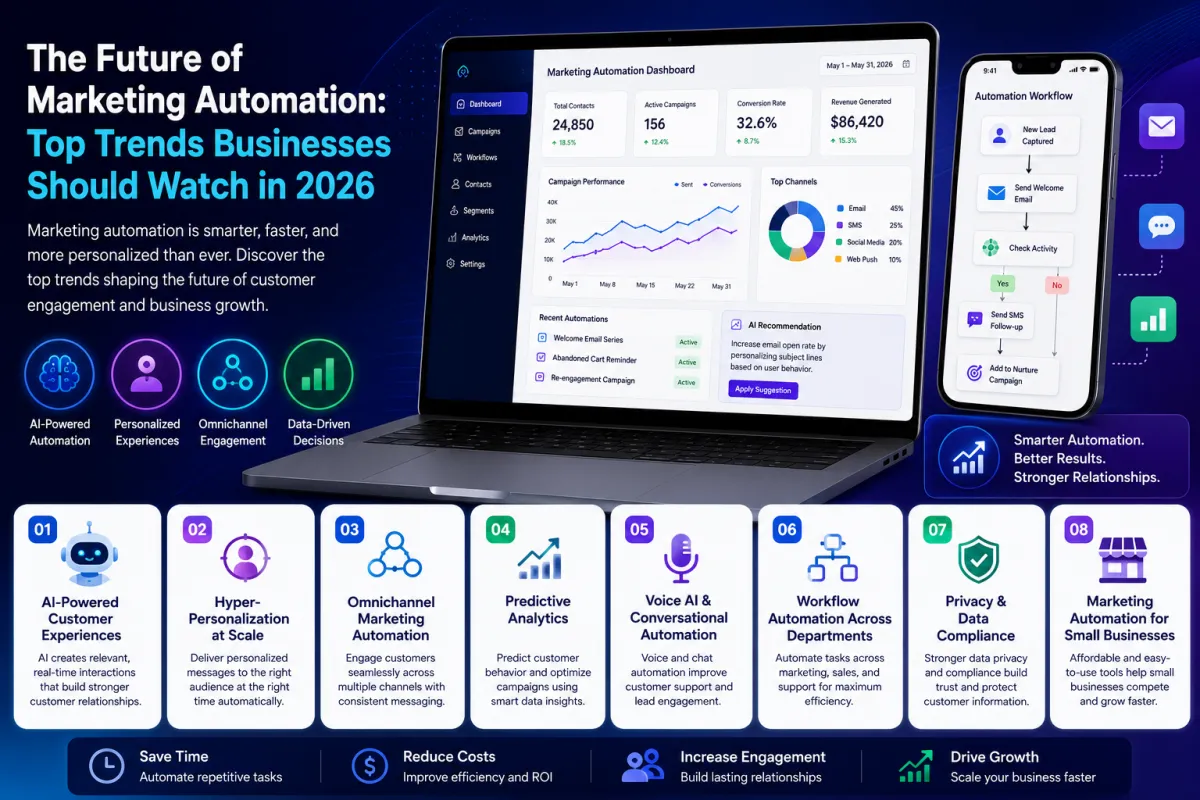
AI-Powered Customer Experiences
-
Hyper-Personalization at Scale
-
Omnichannel Marketing Automation
-
Predictive Analytics and Smart Decision-Making
-
Voice AI and Conversational Automation
-
Workflow Automation Across Departments
-
Privacy and Data Compliance
-
Marketing Automation for Small Businesses
-
Preparing for the Future
-
Frequently Asked Questions
-
Conclusion
Introduction
Marketing has evolved from sending mass emails and generic advertisements to delivering highly personalized experiences across multiple digital channels. Today’s customers expect businesses to understand their preferences, respond quickly, and provide relevant information throughout their buying journey. Meeting these expectations manually is becoming increasingly difficult as customer interactions grow more frequent and complex.
Marketing automation has emerged as a powerful solution, enabling businesses to automate repetitive tasks, manage customer relationships, nurture leads, and deliver timely communication. As artificial intelligence, machine learning, and customer data platforms continue to advance, marketing automation is becoming more intelligent, efficient, and customer-focused.
In 2026, businesses are no longer using automation simply to save time. They are leveraging it to improve customer experiences, optimize decision-making, increase efficiency, and create meaningful interactions across every stage of the customer journey.
Understanding the latest marketing automation trends helps organizations remain competitive while preparing for future technological developments.
What Is Marketing Automation?
Marketing automation refers to the use of software and technology to automate marketing activities and customer communication.
Instead of manually sending emails, scheduling follow-ups, updating customer records, or managing campaigns, automation platforms perform these tasks based on predefined rules and customer behavior.
Common marketing automation activities include:
-
Email campaigns
-
SMS messaging
-
Lead nurturing
-
Customer segmentation
-
Workflow automation
-
Appointment reminders
-
Campaign scheduling
-
Customer onboarding
-
Lead scoring
-
Performance reporting
Automation improves consistency while allowing marketing teams to focus on strategy and creativity.
Why Marketing Automation Is Evolving
Customer expectations continue to rise, while businesses manage increasing amounts of customer data across websites, social media, email, messaging platforms, and mobile applications. Traditional automation based solely on fixed rules is no longer sufficient.
Modern marketing automation increasingly relies on artificial intelligence to analyze customer behavior, predict future actions, and personalize communication automatically.
Several factors are driving this evolution:
-
Growing customer expectations
-
Increased digital competition
-
Advances in artificial intelligence
-
Expanding customer data
-
Greater demand for personalization
-
Improved cloud technology
Businesses adopting these innovations are better positioned to build stronger customer relationships.
AI-Powered Customer Experiences
Artificial intelligence has become one of the most significant developments in marketing automation. AI can analyze customer behavior, identify patterns, and recommend personalized actions based on real-time information.
Examples include:
-
Personalized product recommendations
-
Intelligent email timing
-
Automated customer support
-
AI-generated responses
-
Smart audience segmentation
-
Predictive campaign optimization
Rather than treating every customer the same, AI helps businesses deliver experiences tailored to individual preferences. This improves engagement while increasing marketing efficiency.
Hyper-Personalization at Scale
Customers increasingly expect personalized communication rather than generic promotional messages.
Hyper-personalization uses customer data to create highly relevant experiences across multiple channels.
Businesses may personalize communication based on:
-
Purchase history
-
Website activity
-
Geographic location
-
Customer interests
-
Previous interactions
-
Preferred communication channels
Automation allows thousands of customers to receive individualized experiences without requiring manual effort. Relevant communication often leads to stronger engagement and higher conversion rates.
Omnichannel Marketing Automation
Customers interact with businesses through many different platforms.A potential customer might discover a business on social media, visit its website, subscribe to emails, schedule an appointment, and later contact customer support.
Modern marketing automation connects these interactions into one unified customer journey.
Communication may occur through:
-
Email
-
SMS
-
Social media
-
Live chat
-
Mobile applications
-
Websites
-
Voice assistants
Maintaining consistent messaging across channels improves customer experiences and strengthens brand recognition.
Predictive Analytics and Smart Decision-Making
Predictive analytics uses historical data and artificial intelligence to forecast future customer behavior. Rather than reacting after customers take action, businesses can anticipate likely outcomes.
Predictive marketing helps organizations:
-
Identify high-value leads
-
Forecast purchasing behavior
-
Improve campaign timing
-
Reduce customer churn
-
Optimize marketing budgets
-
Prioritize sales opportunities
These insights allow businesses to make better decisions while improving marketing performance.
Voice AI and Conversational Automation
Voice technology continues to become more sophisticated. AI-powered voice assistants now support customer service, appointment scheduling, lead qualification, and business communication.
Voice automation allows customers to interact naturally without navigating complicated phone menus.
Businesses increasingly use conversational AI for:
-
Customer support
-
Appointment booking
-
Frequently asked questions
-
Order updates
-
Lead qualification
-
Account assistance
Natural conversations improve accessibility while reducing response times.
Workflow Automation Across Departments
Marketing automation is no longer limited to marketing teams. Businesses increasingly automate workflows across multiple departments.
Examples include:
Sales
Lead assignment, follow-up reminders, proposal tracking, and pipeline updates.
Customer Service
Support ticket routing, appointment confirmations, and customer satisfaction surveys.
Finance
Invoice notifications, payment reminders, and billing confirmations.
Human Resources
Interview scheduling, onboarding communication, and employee documentation. Integrated automation improves collaboration while reducing repetitive administrative work throughout the organization.
Privacy and Data Compliance
As businesses collect more customer information, protecting personal data becomes increasingly important. Customers expect organizations to handle their information responsibly and transparently.
Modern marketing automation platforms increasingly include features that support:
-
Consent management
-
Data security
-
Permission tracking
-
Customer preferences
-
Communication controls
Businesses that prioritize privacy strengthen customer trust while supporting compliance with applicable data protection requirements. Responsible data management will remain a critical part of future marketing automation strategies.
Marketing Automation for Small Businesses
Marketing automation is no longer limited to large enterprises. Cloud-based software has made advanced automation accessible to businesses of all sizes.
Small businesses can automate:
-
Lead capture
-
Welcome emails
-
Appointment reminders
-
Customer follow-ups
-
Review requests
-
Payment reminders
-
Customer onboarding
-
Email newsletters
Automation allows small teams to compete more effectively while reducing administrative workloads. As software becomes increasingly affordable and user-friendly, adoption among small businesses is expected to continue growing.
Preparing for the Future
Businesses should begin preparing now for continued advancements in marketing automation.
Important priorities include:
-
Investing in accurate customer data.
-
Improving workflow efficiency.
-
Implementing AI responsibly.
-
Maintaining customer privacy.
-
Training employees on automation tools.
-
Regularly reviewing campaign performance.
-
Adapting strategies based on customer behavior.
Organizations that embrace continuous improvement will be better positioned to benefit from future automation innovations.
Frequently Asked Questions
What is marketing automation?
Marketing automation is the use of software to automate marketing tasks such as email campaigns, lead nurturing, customer communication, workflow management, and campaign reporting.
Why is AI important in marketing automation?
Artificial intelligence helps businesses personalize customer experiences, analyze data, predict customer behavior, automate conversations, and optimize marketing performance more effectively.
Can small businesses benefit from marketing automation?
Yes. Small businesses can automate repetitive tasks, improve customer communication, save time, and increase efficiency without requiring large marketing teams.
What is omnichannel marketing automation?
Omnichannel marketing automation coordinates customer communication across multiple channels such as email, SMS, websites, social media, and mobile applications to create a consistent customer experience.
How will marketing automation continue to evolve?
Future developments are expected to focus on greater AI integration, predictive analytics, advanced personalization, conversational automation, improved privacy management, and deeper business process automation.
Conclusion
Marketing automation is evolving into a smarter and more connected approach to customer engagement, combining artificial intelligence, predictive analytics, personalization, and workflow automation to improve business performance. Organizations that adopt modern automation strategies can streamline repetitive tasks, enhance customer experiences, make data-driven decisions, and respond more effectively to changing market demands. As technology continues to advance, businesses that embrace innovation while maintaining a strong focus on customer value, privacy, and operational efficiency will be better equipped to achieve sustainable growth and remain competitive in the digital marketplace.